
How do Affirmations Rewire Your Brain?
For decades, affirmations have been seen as feel-good phrases or self-help mantras. But behind the repetition of “I am enough” or “I am strong” lies something deeper—something that neuroscience is just beginning to unpack.
So why are affirmations powerful? The answer lies in your brain’s ability to rewire itself, the psychology of identity, and how language influences the subconscious mind. In this article, you will learn the science behind affirmations and why they actually work.

What Are Affirmations, Really?
Affirmations are short, positive statements meant to strengthen a belief or mindset. But the most powerful affirmations aren’t vague or feel-good fluff—they’re grounded in psychology and behavior change.
According to experts like Dr. Carol Dweck, author of the book Mindset: The New Psychology of Success, and Dr. Andrew Huberman, a neuroscientist at Stanford, affirmations that focus on effort, identity, and resilience create the deepest and most lasting impact.
These are known as identity-based affirmations—and they work because they help rewire your brain over time. Instead of telling yourself something your subconscious may not believe, you affirm the kind of person you’re becoming.
For example, instead of saying:
“I am successful,”
you could say:
- “I grow through challenges and build success step by step.”
- “I’m the kind of person who creates success through consistent action.”
- “I embody the habits and mindset of someone who achieves their goals.”
Why does that matter?
Because it doesn’t just tell your brain what you want. It tells your brain who you’re becoming. And that’s where real change happens.
The Neuroscience of Affirmations
When you say an identity-based affirmation with intention, you activate:
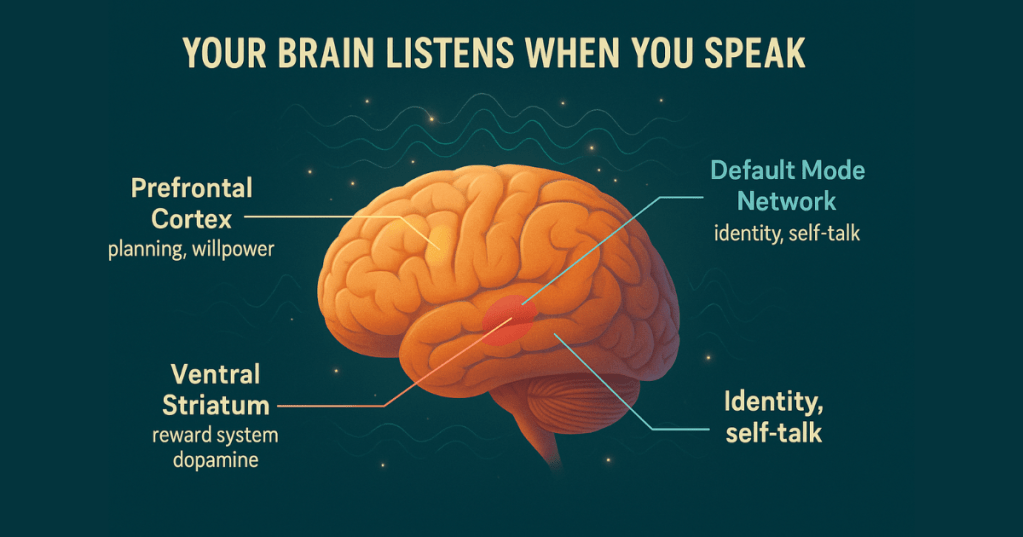
- The prefrontal cortex: This part of your brain handles planning, discipline, and focus. Affirmations that reinforce effort (e.g., “I keep going even when it’s hard”) light up this region.
- The reward system (ventral striatum): Repeating self-affirming statements can trigger dopamine, your brain’s motivation molecule.
- The default mode network: This is your brain’s internal narrative system—the part that quietly tells you who you are. When you feed it new, empowering beliefs, it begins to reshape how you see yourself.
A 2016 study published in Social Cognitive and Affective Neuroscience found that self-affirmations increased activity in the ventromedial prefrontal cortex, an area associated with self-worth and emotional regulation.
Why Identity Matters More Than Positivity
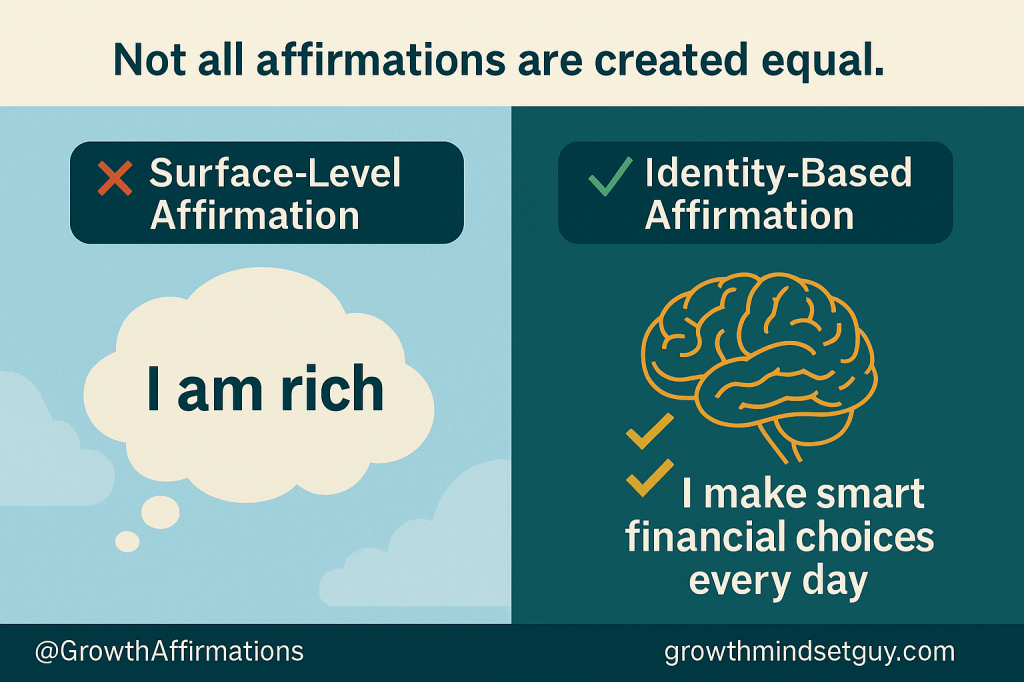
Generic affirmations like “I am successful” can create cognitive dissonance if your subconscious doesn’t believe them. But affirmations rooted in identity and behavior, such as:
“I am the kind of person who stays calm under pressure”
…are more believable. Your brain can integrate them because they reflect a pattern of who you’re becoming—not just what you wish for. It’s not just what you say—it’s who you tell your brain you’re becoming. That’s where the real change happens.
That’s why effort-based praise is so effective (Dweck, 2006). It reinforces behaviors that lead to real change.
The Best Time to Use Affirmations
Your brain is most impressionable during:
- Early morning (alpha brainwave state)
- Right before bed (theta brainwave state)
- After deep breathing or meditation
In these moments, the subconscious mind is more open to new programming.
Say your affirmation out loud. Repeat it slowly. Visualize what it means. This activates not only the language centers of the brain, but the sensorimotor system, making it feel more real.

How Affirmations Build Resilience
When practiced consistently, affirmations help:
- Reduce stress by calming the amygdala (your fear center)
- Build mental toughness by reinforcing identity
- Strengthen habit loops by pairing words with action
Over time, this creates new neural pathways—the foundation of neuroplasticity.
The result? You don’t just think differently. You become different.
Try This: One Powerful Affirmation
Instead of a list, try going deep on one phrase. Here’s one backed by neuroscience, psychology, and experience:
“I am the kind of person who turns challenges into training for my future self.”
This single sentence carries identity, grit, and growth.
Say it in the mirror. Say it in your mind. Say it until it becomes part of how you face challenges.
Want to Go Deeper?
Discover the most powerful science-backed affirmation that rewires your brain.
According to neuroscience and psychology research, the most powerful affirmation is one that rewires your mindset by focusing on effort and identity—not just outcome. In this video below, you’ll discover what it is and why it works.
Affirmations are powerful not because they magically manifest success, but because they train your brain to believe new truths. They reinforce effort, reshape identity, and activate the systems responsible for resilience and motivation.
Start with one. Repeat it often. And let your words build the mindset you need.
Related Resources:
- Growth Mindset Affirmations for Entrepreneurs
- How to Build Mental Toughness with Identity Statements
- Neuroplasticity Explained Simply
Backed by science. Rooted in growth.
 Marko Ceki
Leave a comment